
Getting Health Insurance Claims Reporting Back to the Future at NESA 2026
October 2026
KEY TAKEAWAY
- Schools need detailed monthly claims reporting to make informed decisions about costs and faculty care.
- Check the underlying figures, allow for claims reporting delays and protect individual confidentiality.
- Use the evidence to guide renewal and plan design discussions, including with your existing insurer.
At this week’s NESA Fall Leadership Conference in Bangkok, I ran a session called “Getting Back to the Future: Your Insurance Claims Reporting Hasn’t Changed Since 2006”.
The question was straightforward: how can schools make informed decisions about health insurance when their claims reports don’t give them the information they need?
Why Claims Reporting Matters Now
For the last two NESA conferences, I’ve talked about smart plan design: controlling costs while protecting faculty care. Medical costs keep rising, school budgets are under pressure, and health insurance is a substantial investment in the people a school depends on.
But I’d skipped an assumption. Smart plan design starts with claims data. You need to understand what is driving costs, who uses each benefit and what a proposed change would mean for them.
Many schools simply don’t have that information. They’re being asked to run a 2026 budget on 2006 reporting.
What Useful Reporting Looks Like
I compared a limited claims report with a detailed pack covering three years. The difference was what each allowed us to understand: claimant numbers, cost per person, high-cost claims, benefit use and changes over time.
Alongside the PDF, we ask for a monthly claims data file, with appropriate privacy protections. That lets the broker check the figures and investigate questions the summary cannot answer.
Page count isn’t the test. Can your report answer the questions you need answered, and can the figures be checked?
Why Monthly Reporting Matters
Annual reporting leaves little opportunity to respond during the policy year. Quarterly reporting can also arrive too late, particularly when schools need to agree benefits well before a July or August renewal.
Monthly reporting, viewed over a rolling twelve months, helps build a picture earlier. It still needs to account for delays in claims being reported.
The school doesn’t have to do all the analysis. Our clients receive a concise monthly summary explaining what has changed, whether anything needs attention and what we recommend.
Review Your Claims Reporting
We can review the reporting you receive, identify missing detail and explain what to request from your insurer.
Insurer Objections and Privacy
Schools asking for more detail often hear familiar responses: “It’s not needed.” “We do this for you.” “Monthly isn’t useful.”
When you’re spending a substantial sum on health insurance, asking for evidence behind the renewal is good governance. Some insurers already provide detailed reporting, so schools have a practical standard to request.
Privacy needs proper attention. Removing names and replacing member IDs with codes does not automatically make a dataset anonymous. Rare conditions, treatment dates or small groups can still make someone recognizable.
Reporting should remove identifying details and combine or suppress small groups where needed. Detailed files also need appropriate access controls. School leadership should receive the information needed to manage the plan while protecting individual confidentiality.
What an AI Test Showed
I gave the same AI tool four examples of insurer claims reporting, using the same prompt. It asked for the AI to separate membership changes from genuine cost changes, identify the main drivers, assess savings opportunities and explain what the data could not support. One instruction mattered particularly: don’t invent numbers.
With limited reporting, the AI could flag questions to investigate, but could not reliably distinguish recurring trends from one-off events or calculate defensible savings.
With the detailed report, it could explain much more. Lower spending on outpatient medicines and treatment in the United States were major contributors to the fall in claims. That distinction matters: understanding why spending fell helps you assess whether the improvement might continue.
The exercise showed how better data supports better questions. AI suggestions still need checking against the underlying figures before they inform a renewal or benefit change.
Use an approved AI environment with appropriate privacy controls and only data your organization is authorized to process. Never upload identifiable claims data to a public AI tool.
Get the AI Prompt from the Session
Ask for the exact prompt I used to assess the four claims reports, including the instruction not to invent numbers.
Setting Limits with Evidence
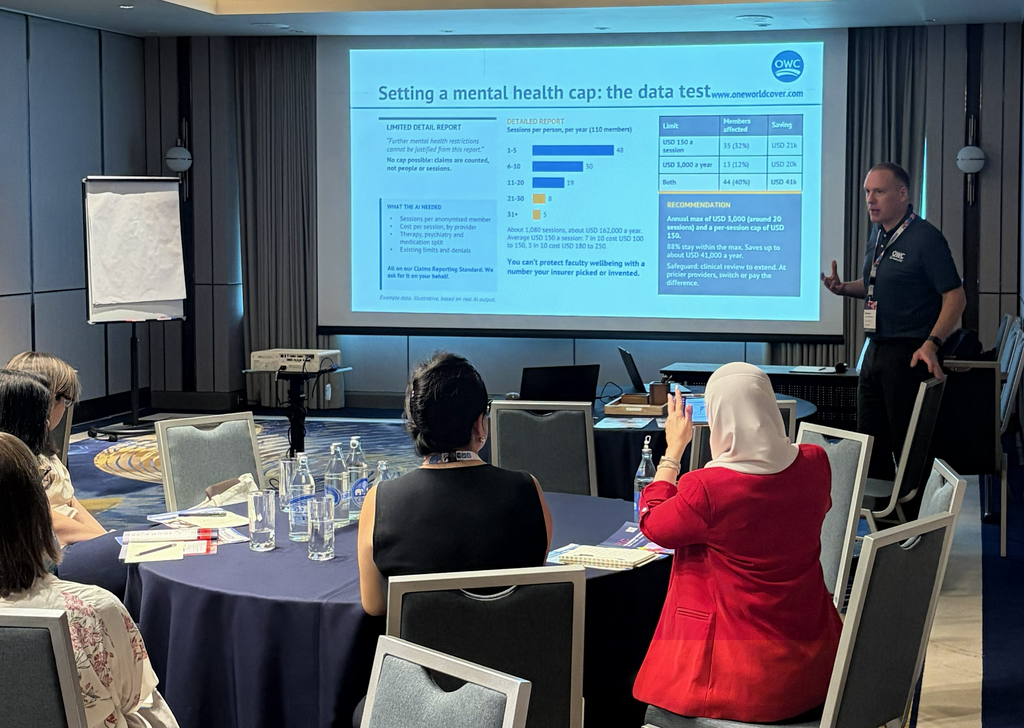
Mental health and physiotherapy often come up in discussions about plan design. Without sessions per person and cost per session, it is difficult to assess what a cap would do.
I used an illustrative mental health example showing a 20-session annual limit, with clinical review for people needing additional treatment. Usage data lets you estimate how many people might be affected and model potential savings, including the cost of clinically necessary extensions.
Physiotherapy provided a practical example. At one school, we introduced a per-session cap of RMB 800, and the providers used by staff matched it. That experience shows why understanding local prices and provider options matters before setting a limit.
Other options include negotiating provider rates or using a higher co-pay at selected expensive providers. A higher co-pay does increase what members pay if they use those providers. Any proposal needs to explain that impact and assess whether suitable alternatives are available.
You Can Keep Your Insurer
Schools that value their insurer’s service can use that relationship to ask for better reporting.
Many schools appoint One World Cover to help obtain the information, understand it and use it at renewal. Claims analysis, faculty feedback and informed negotiation can change the renewal conversation without requiring a change of insurer.
Make the reporting requirement specific: monthly reports, a rolling twelve-month view, claimant counts, cost per claimant, benefit and provider breakdowns, and appropriate detail on high-cost claims. Agree how the underlying data will be shared and protected.
Keep Your Insurer. Improve Your Reporting.
One World Cover can help you obtain and analyze claims data and use it in renewal discussions, while retaining your current insurer.
What Came Up in the Q&A
Claims lag. Recent months can look artificially light because claims have not yet been reported. We look at reported claims by treatment date alongside an estimate for claims incurred but not yet reported, known as IBNR. A rolling twelve-month view still needs that allowance. Continuing it across a change of insurer requires consistent information from both insurers.
Plan design timing. Some schools communicate benefits with employment contracts early in the year. One school we work with makes plan design decisions in September. Early decisions are possible when the analysis starts early enough.
Frequently Asked Questions (FAQs)
How often should a school receive claims reports?
Monthly, with a rolling twelve-month view by treatment date and an appropriate allowance for claims reporting delays. This gives schools more opportunity to investigate changes before renewal decisions are due.
Does detailed claims reporting put staff privacy at risk?
It needs careful handling. Removing names alone is insufficient. Reports should combine or suppress small groups where needed, minimize identifying details and restrict access appropriately.
Do we need to change insurer to get better reporting?
No. Schools can use their existing relationship and renewal discussions to request more detailed reporting. One World Cover can help define the requirements and analyze what comes back.
Get the Claims Reporting Standard
If you’d like our one-page Claims Reporting Standard, or the full AI prompt I used in the session, email me at [email protected].
Better reporting gives schools a stronger basis for controlling costs while protecting the care their faculty value.



About the Author
