
Happy, Healthy Teachers Create Thriving Schools: Are You Creating Conditions to Thrive?
Published: October 2026
KEY TAKEAWAY
Faculty wellbeing is shaped by the everyday experience of working in a school: workload, relationships, professional trust and access to support. A wellbeing initiative should improve that experience, with time and resources behind it.
“Happy, healthy teachers create thriving schools.”
That was the message I brought to the FOBISIA Business Conference in April 2026. Faculty wellbeing belongs in the same leadership conversation as educational quality, recruitment, retention and financial sustainability. It deserves a place in the school’s operating decisions and budget.
A recent COBIS webinar, Building a culture of wellbeing: ideas to impact, offered a useful perspective on what that commitment looks like in practice. Nicola Wilson, KS2 Phase Coordinator at St George’s British International School in Rome, and her colleague Emma, shared their experience of developing wellbeing through a professional learning community.
What made their presentation valuable was its honesty. They described meaningful progress, initial skepticism and work still to do. They also acknowledged a particularly important distinction: encouraging signs for student wellbeing did not mean faculty wellbeing had been solved.
For international school leaders, that is worth paying attention to.
A wellbeing initiative can become another source of pressure
One of the most revealing moments came when Emma described her initial reaction to joining the professional learning community: another initiative, another demand on an already full workload.
It is a response school leaders will recognize.
A new framework, survey or working group may have excellent intentions. But teachers experience it through the time it takes and the other responsibilities competing for their attention.
The St George’s team addressed this by giving the group a clear purpose, practical tasks and protected meeting time. Staff could see what they were contributing and what the work was intended to change.
There is a straightforward test here for any school: If we are asking teachers to do something new, what time, support or reduction elsewhere are we providing? That question should be part of the proposal from the beginning.
Look beneath the visible activities
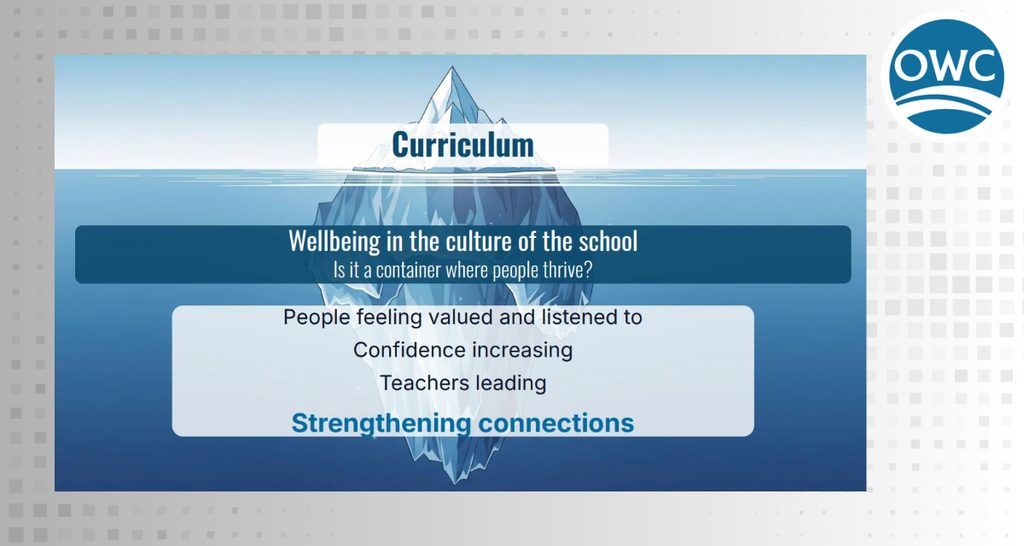
The presenters used an iceberg model to explain their approach.
At the visible level was a specific task: improving the school’s personal, social, health and economic education curriculum, or “PSHE”.
Below that sat the wider culture of the school. And beneath that were the relationships and experiences that sustain it: people feeling heard, confidence growing and teachers having opportunities to lead.
This is a useful way to assess faculty wellbeing.
Schools can easily show a calendar of activities. It is harder, but more revealing, to establish whether staff feel comfortable asking for help, have enough time to do their jobs well and trust that their feedback will lead to action.
A school can have a busy wellbeing calendar while its teachers are exhausted. Leaders need to understand both.
Listen during the working day, then show what changed
The St George’s team gathered feedback from staff, students and parents. They kept the process accessible and used existing opportunities, including staff meetings and a parent coffee morning.
Staff were given time to contribute. Students helped lead the student audit, with specialist colleagues checking that it was accessible.
The team then shared the findings and invited staff to help shape the response. Three priorities emerged: recognition, resilience and challenge in learning.
The lesson for faculty wellbeing is the process, rather than copying those particular priorities.
Ask staff what is working and what is making their jobs harder. Give them time to answer. Share the themes without exposing individuals. Then explain what the school will change, who will take responsibility and when progress will be reviewed.
Repeatedly asking for feedback without a visible response risks making the next survey feel pointless.
Book a Benefits Communication Review
Help faculty understand where to get support and how to use the benefits your school provides.
Clarity and professional trust can reduce friction
The curriculum work provides a practical example. Teachers already had substantial material, but it was difficult to navigate and lacked consistent progression between year groups. The response was to create clearer objectives and a more usable framework while preserving teachers’ discretion over delivery. That matters beyond PSHE.
Unclear expectations, duplicated tasks and hard-to-find information all consume time. Improving them may be less visible than launching a new wellbeing program, but it can make the working day easier.
School leaders could start by asking:
- Which processes require teachers to enter the same information more than once?
- Which meetings need everyone present?
- Where are expectations unclear or changing without explanation?
- Which resources could be made easier to find and use?
- Where could teachers have more discretion over how they achieve an agreed outcome?
Faculty wellbeing is partly shaped by these ordinary management decisions.
Student progress does not automatically mean staff progress
The COBIS webinar presenters were careful about their results.
They described encouraging early indications for students and stronger opportunities for participation and connection. But they were only partway through implementation, with further reflection planned. Staff wellbeing remained mixed.
That distinction matters. This was an account of work in progress, not proof that a particular model had solved wellbeing.
During the discussion, the presenters returned to workload, the timing of new initiatives and the importance of acknowledging pressure. Report-writing periods, for example, are a poor moment to introduce another substantial demand.
Nicola put one point particularly clearly: “staff wellbeing is not cake in the staff room.”
Small gestures can be welcome. They become more meaningful when accompanied by enough time, practical support and an honest response to the pressures staff describe.
Where health insurance and employee benefits fit
This connects with the argument I made at FOBISIA: faculty wellbeing needs to be treated as part of a school’s foundations, supported by a coherent combination of benefits, mental health access, professional development and practical care.
READ MORE >> OWC at FOBISIA Business Conference 2026: Building Schools that Thrive
For One World Cover, the benefits question is practical: can teachers and their families get the support the school believes it has provided?
A policy document alone does not answer that. Schools should understand whether staff know how to access care, what mental health support is available under their plan, where restrictions apply and who can help when a claim or treatment becomes complicated.
Those questions matter particularly when employees are navigating an unfamiliar healthcare system.
Health insurance cannot resolve excessive workload or poor management. Equally, a supportive working culture does not remove the need for accessible healthcare. Both deserve attention.
Review Mental Health Benefit Access with Us
Examine the limits, access routes and out-of-pocket costs that shape whether faculty can use their mental health benefits.
What could your school change this term?
My suggestion is to start with a manageable commitment.
Choose one source of avoidable workload and one barrier to accessing support. Involve the people affected in deciding what to change. Give someone responsibility, allocate time and agree when you will review the result.
Measure the experience, not simply whether an activity happened. Did the change save staff time? Is the process clearer? Do people know where to get help? What remains difficult?
The COBIS webinar was a useful reminder that building a culture of wellbeing takes patient, practical work. It also requires leaders to hear when something has not helped as much as they hoped.
Happy, healthy teachers create thriving schools. The responsibility for creating the conditions that support them belongs across the leadership team, every day.
Note: This article draws on the recent COBIS webinar “Building a culture of wellbeing: ideas to impact”, presented by Nicola Wilson from St George’s British International School, Rome (view webinar slides here). The school examples come from Nicola and her colleague Emma’s presentation and discussion; the benefits recommendations reflect One World Cover’s perspective.
Frequently asked questions
How can a school improve faculty wellbeing without adding to workload? Use existing meeting time to identify specific pressures, simplify processes and agree a small number of changes. Any new responsibility should come with time, resources or a clear decision about what will stop.
How should schools assess whether their approach is working? Combine staff feedback with evidence relevant to the change, such as time saved or improved access to support. Review faculty and student wellbeing separately, and avoid treating participation in an activity as proof of improvement.
What role should employee benefits play? Benefits should provide practical, clearly communicated support that staff can access when needed. Schools should review healthcare access and mental health provisions alongside workload, leadership and the wider staff experience.
Book a Faculty Benefits Strategy Call
If your school is reviewing how health insurance and employee benefits support faculty wellbeing, get in touch with One World Cover. We can help you examine access to care, understand your plan’s limitations and consider how to protect the support your people value while managing costs.
One World Cover is an independent international insurance broker and employee benefits consultant, not an insurer.



About the Author
